Smooth Council Approvals
Meets Townsville City Council development assessment requirements without costly planning delays.
Comprehensive, legally defensible tree assessments by qualified AQF Level 5 consulting arborists.
Providing formal arborist reporting across Railway Estate, Hermit Park, and all Townsville.
When you need an authoritative arborist report Railway Estate wide, our consulting team delivers clear, comprehensive documentation. From residential development approvals to formal hazard risk analyses, we provide the technical data required by councils, insurers, and engineers.
In Railway Estate, coastal salt spray, black clay movement, and seasonal drought stress affect tree health in unique ways. Our AQF Level 5 reports detail how soil moisture shifts and planting defects contribute to tree instability on local sites.
Meets Townsville City Council development assessment requirements without costly planning delays.
Provides clear, unbiased documentation for boundary disputes, insurance claims, and risk management.
Allows architects and builders to design footings and services around viable trees safely.
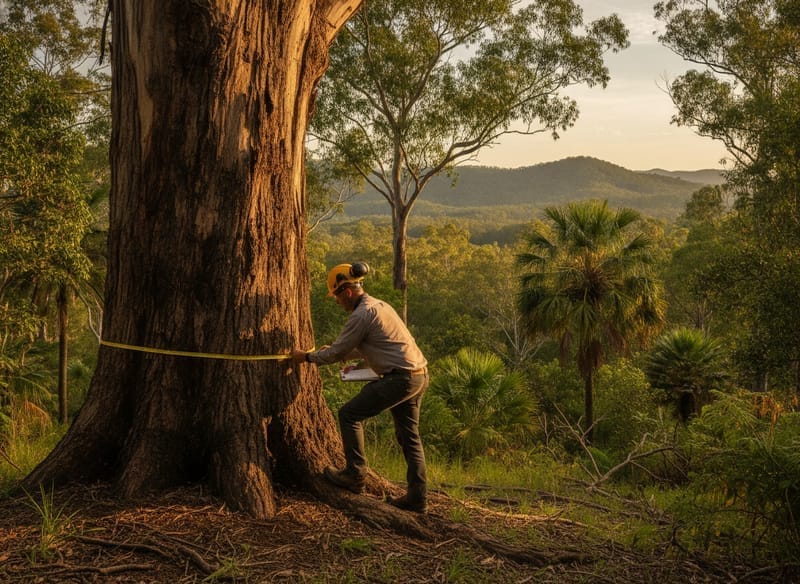
Our AQF Level 5 arborist visits your Railway Estate property to measure diameter at breast height (DBH), height, and canopy spread.
We assess trunk soundings, root flare condition, canopy vitality, and presence of fungal or termite damage.
We calculate TPZ, SRZ, and risk ratings in accordance with AS4970-2009 and local planning benchmarks.
You receive a formal, fully illustrated digital PDF report ready for submission to council, certifiers, or insurers.
Townsville's dry tropics climate creates an incredibly challenging environment for large trees. Extended periods of intense drought followed by cyclonic wet seasons place immense structural stress on mature canopies. When you need a professional Arborist Report Railway Estate, our AQF Level 5 consulting arborists provide the exact, scientifically backed documentation required to protect your property and satisfy all legal obligations.
Railway Estate’s unique position on the coastal strip brings its own set of environmental variables, from sandy, salt-exposed soils to the strict marine plant protections along tidal edges. Whether you are a homeowner dealing with a potentially hazardous tree, a developer submitting a local council application, or a property manager handling an insurance claim after severe weather events like Cyclone Kirrily, you need local expertise.
We provide detailed, independent, and highly accurate arborist reports. Our team understands the specific failure modes of Townsville tree species, ensuring your documentation stands up to rigorous scrutiny from council, insurers, and builders.
Managing large trees in Townsville is vastly different from managing trees anywhere else in Australia. Relying on an unqualified opinion rather than a formal Arborist Report Railway Estate can lead to disastrous consequences. An untrained eye will often miss critical below-ground defects, such as the historical nursery pot root-binding that causes mature African Mahogany trees to uproot entirely when our soils transition from concrete-hard to saturated during the wet season.
Furthermore, poor advice exposes you to severe legal and financial liabilities. Townsville City Council does not have a blanket tree preservation order for private trees, but there are strict triggers if your land falls within the OM-08 Natural assets overlay. More critically for Railway Estate, the tidal edges and proximity to the Ross River mean mangroves and marine plants are strictly protected under the state Fisheries Act 1994. Trimming a protected marine plant based on bad advice carries massive fines.
Our AQF Level 5 consulting arborists solve this by delivering scientifically sound, legally robust reports. We correctly identify the species, accurately assess structural integrity, and cross-reference your specific address against local overlays and state legislation. This ensures you have clear, compliant, and actionable data before any of our climbers or trucks arrive to commence physical work.
Our consulting arborists draft highly technical, legally binding documents that comply with all relevant Australian Standards. We tailor every report to address Townsville’s dry tropics climate and your specific project requirements.
Comprehensive documentation required when building works intersect with local overlays. We detail tree inventory, species identification, DBH (Diameter at Breast Height), and provide a SULE (Safe Useful Life Expectancy) rating. Our reports clearly state retention recommendations and define necessary setbacks.
Mandatory for construction sites with retained vegetation. We calculate and map the Tree Protection Zone (TPZ) and Structural Root Zone (SRZ) in strict accordance with AS4970. This includes specifying protective fencing, root mapping protocols, and supervised excavation zones to ensure builders do not compromise tree stability.
A detailed risk assessment utilizing internationally recognized VTA principles. We document canopy defects, termite hollowing, and root plate instability. We assess the likelihood of failure and the consequence to target zones (homes, powerlines, pedestrian areas), providing a clear matrix for hazard mitigation.
Formal documentation required to utilize the Vegetation Management Act 1999 standing imminent risk exemption. We photograph and document structural failures, proving the tree poses an imminent risk of serious personal injury or damage to infrastructure, keeping your removal completely legally compliant.
Post-cyclone or storm damage analysis. We provide expert documentation detailing why a tree failed—whether due to extreme wind loads, pre-existing decay, or root plate saturation—which is critical for insurance claims and liability disputes.
Delivering a comprehensive Arborist Report Railway Estate requires a meticulous, step-by-step approach to ensure nothing is missed. Step one is the initial consultation and site visit. Our AQF Level 5 consulting arborist will attend your property to visually inspect the trees in question, taking note of the site topography, soil conditions (whether coastal sand or heavy clay), and the surrounding infrastructure. Step two involves rigorous field data collection. We utilize specialized tools to measure trunk diameter, map canopy spread, and conduct a Visual Tree Assessment (VTA) to identify structural weaknesses, termite hollowing, or early signs of decay. For high-risk species like the Yellow Flame Tree, we specifically assess branch attachment strength. Step three is our regulatory compliance check. We cross-reference your specific property boundary against the Townsville City Plan's OM-08 Natural assets overlay, the state Regulated Vegetation Management Map, and local marine plant boundaries. Step four is the drafting phase, where all field data and legislative findings are compiled into a formal, structured PDF report. Finally, step five is the handover and strategy session. We deliver the finalized report and walk you through the recommendations, outlining whether you need an AS4970 protection plan for an upcoming build or if our AQF Level 3 climbing arborists need to be dispatched for an urgent, hazard-reduction removal.
Every consulting report we produce is authored by an AQF Level 5 Diploma-qualified arborist, which is the mandatory standard required by Townsville City Council and state planning authorities. Our business operates completely above board, maintaining full public liability insurance, professional indemnity insurance for consulting services, and comprehensive WorkCover for our entire team.
We strictly adhere to AS4373 (Pruning of Amenity Trees) and AS4970 (Protection of Trees on Development Sites). By following these definitive Australian Standards, we ensure that our risk assessments and tree protection plans are scientifically robust, legally defensible, and perfectly aligned with best-practice arboriculture in cyclonic regions.
Railway Estate is a unique suburb that requires hyper-local knowledge. While Townsville is generally one of the freer places in Australia regarding tree removals on private land—meaning there is no blanket council tree preservation order—Railway Estate properties face distinct geographical constraints.
Because the suburb borders the Ross River and various tidal inlets, the state Fisheries Act 1994 is a major factor. All marine plants, particularly mangroves, are heavily protected, and even minor trimming constitutes an offence. Furthermore, if your block intersects with the Townsville City Plan OM-08 overlay for very high importance natural assets, clearing becomes code assessable.
Our reports focus on the realities of the dry tropics. We frequently assess mature River Blue Gums and Weeping Paperbarks that have thrived in the coastal water table but face extreme wind-loading during our November to April cyclone season. We understand the dominant local failure mechanism: uprooting due to saturated soils under heavy cyclonic gusts. Our advice is pragmatic, targeted, and highly localized.
Once your report is delivered, the required action depends on your initial objectives. If the report was drafted for a development application, the AS4970 Tree Protection Plan must remain on-site, and all protective fencing must be erected before earthworks commence. If the report identifies a hazardous tree requiring action under an imminent risk exemption, you can engage our team of AQF Level 3 climbing arborists to safely dismantle it. For retained mature trees, we highly recommend scheduling an annual visual reassessment with us just before the wet season to monitor any changes in structural integrity.
Arborist report pricing is based on the report type, scope of development, and number of trees being evaluated.
We offer fixed-price quotes for all consulting arborist reports with no unexpected revisions.
We provide AQF Level 5 arborist reports throughout Railway Estate and the wider Townsville region:
Contact Townsville Arborist for AQF Level 5 arboricultural consulting and DA-compliant reports.
Request a Quote